
What Is the Duckworth-Lewis Method in Cricket?
Have you ever watched a cricket fit wherein the rain stopped the sport and the target all at once changed? You may additionally have puzzled why the crew batting 2nd scored fewer or extra runs than predicted.
The solution is normally the Duckworth-Lewis-Stern (DLS) approach. It is a gadget used to set a revised goal whilst rain or every other interruption reduces playing time in a limited-overs cricket suit.
In this guide, we are able to provide an explanation for the DLS technique in simple phrases, how it works, and the way it may have an effect on the result of a cricket match.
What is the Duckworth-Lewis-Stern (DLS) Method?
The Duckworth-Lewis-Stern approach is a mathematical machine used to calculate a honest target whilst a cricket match is shortened because of rain or every other interruption.
It is especially utilized in One Day Internationals (ODI) and T20 cricket. When a suit loses overs, each groups may not get the same opportunity to attain runs. The DLS method adjusts the goal to account for this difference.
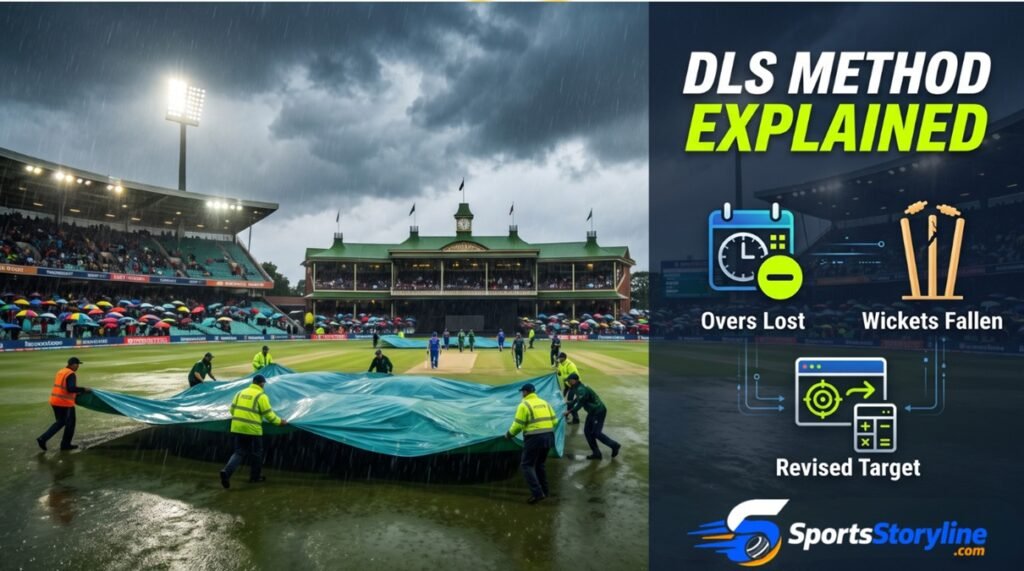
The device considers considerable things:
- Overs final: How many overs a crew nonetheless has to attain runs in?
- Wickets last: How many batters a team still has before its innings stop.
The primary idea is easy: A team with more overs and more wickets available usually has a better risk of scoring runs.
The International Cricket Council (ICC) uses the DLS method to set revised goals in interrupted fits.
Why Is the DLS Method Needed in Cricket?
Imagine Team A bats first in a 50-over fit and scores 280 runs. Team B starts offevolved its chase, however rain stops the fit after 20 overs.
If the healthy resumes with fewer overs to be had, Team B can not be anticipated to chase the original goal under the equal conditions.
Without proper adjustment, one crew may want to get hold of an unfair benefit due to the interruption.
The DLS method considers how lots batting possibility every team has and calculates a revised goal whilst required. This enables make the result honest.
How Does the DLS Method Work?
The DLS method compares scoring possibilities for each teams. These possibilities are called batting assets.
There are three primary steps to information:
1. Calculate the to be had assets
At the start of a regular 50-over innings, a crew has 50 overs and 10 wickets available. As the innings hold, its final sources decrease.
For example, a group with 10 overs left and eight wickets in hand might also have a stronger scoring possibility than a crew with 10 overs left and best 2 wickets last.
2. Check how the interruption changed the in shape
If rain reduces the variety of overs, groups may also lose one of a kind amounts of batting opportunities.
The DLS approach uses the overs final and wickets in hand to degree these modifications.
three. Set a revised target
The DLS calculation compares the resources to be had to each crew and determines the precise target for the second one team.
The target may additionally boom or decrease, relying on the circumstances. Overs aren’t certainly reduced by means of the equal percent.
The official calculation makes use of a mathematical model and aid values rather than a easy run-rate calculation.
A Simple Example of the DLS Method
Let’s recognize the idea through a hypothetical example.
Suppose Team A scores 250 runs in its 50-over innings. Team B starts offevolved chasing the goal, but rain interrupts the in shape and reduces the final gambling time.
Team B now has fewer runs to attain the unique 251 runs target.
Match officials use the DLS method to calculate a revised target primarily based on suit state of affairs.
Match situationWhat it meansOriginal target251 runsRain interruptionAvailable overs are reduced for DLS calculationThe teams’ batting sources are comparedRevised targetSet according to the official calculation.
Please be aware: The instance above explains the technique, not an real DLS end result. The revised target can not be calculated from the authentic score on my own. We also need info which includes the overs lost and the wickets closing at the applicable stages of the healthy.
Does the DLS Method Always Reduce the Target?
No. The DLS approach does not usually lessen the target.
The revised goal relies upon on when the interruption occurs and the way the to be had batting sources exchange.
For example,
- Rain interrupts team B’s chase: Team B might also get hold of a lower target if it has much less batting time available.
- Rain reduces Team A’s innings: Team B can be set a exclusive goal based totally on both teams’ resources.
- Team B has extra beneficial resources than Team A had. The calculation can bring about a better goal in some conditions.
The cause is to examine the opportunities to be had to both groups, no longer to mechanically favour the second one-batting group.
What Is the Difference Between Duckworth-Lewis and Duckworth-Lewis-Stern?
Duckworth-Lewis approach developed through statisticians Frank Duckworth and Tony Lewis. It turned into brought to worldwide cricket within the past due 1990s.
Later, statistician Steven Stern up to date the approach. The gadget became called the Duckworth-Lewis-Stern approach, or DLS, in 2014.
The up to date method become designed to improve target calculations for modern-day restricted-overs cricket, where scoring patterns have changed.
Cricket enthusiasts and commentators generally use the time period DLS approach.
How Is the DLS Target Calculated?
The professional DLS technique is greater designated than a primary mathematical formula. It uses every group’s batting resources.
In a simplified explanation, the calculation compares:
- The resources are to be had to Team A.
- Team B’s assets.
- The runs had been scored via Team A.
- Interruptions have an effect on the overs and wickets to be had.
The DLS system uses aid values to calculate the revised target. Officials use the permitted calculation technique for the competition.
This is why two fits with the identical first-inning rating will have one of a kind revised objectives if interruptions occur at one-of-a-kind tiers.
Can a Team Win a Match Under the DLS Method?
Yes. A suit can be gained the use of a DLS-adjusted goal.
Suppose Team B is chasing a revised target after rain shortened the in shape. If Team B reaches the desired target beneath the relevant gambling situations, it wins.
However, if the fit cannot hold, officers may want to examine Team B’s score with the relevant DLS par rating. This is furnished the match meets the competition’s requirements for a end result.
If the required minimal amount of play has now not taken area, the healthy may be abandoned or declared a no-end result, relying at the opposition’s rules.
The actual end result relies upon on the format and playing situations.
Common Questions About the DLS Method
1. What does DLS stand for in cricket?
DLS stands for Duckworth-Lewis-Stern, the method used to revise targets in interrupted limited-overs matches.
2. Is the DLS method utilized in Test cricket?
The DLS approach is designed for limited-over cricket, including ODIs and T20 matches. It isn’t the normal approach of figuring out Test in shape outcomes.
three. Is the DLS approach based totally most effective on the run rate?
No. It considers the mixture of overs remaining and wickets in hand, along with the runs scored and the impact of interruption.
four. What is the reason for a few DLS targets increasing?
A target may be increased when the aid assessment suggests that the group batting 2nd has a more beneficial scoring possibility than the team batting first had.
five. Who calculates the DLS goal for the duration of a suit?
Match officers use the approved DLS calculation gadget and the applicable opposition policies to determine the revised goal.
6. Does rain always lead to DLS effects?
No. If enough play isn’t feasible, a fit might also end with out a result. The outcome relies upon on the applicable gambling situations.
Final Thoughts
Duckworth-Lewis-Stern approach is a critical part of cutting-edge constrained-overs cricket. It enables officers set a revised target whilst rain or another interruption reduces play time.
The simplest manner to understand DLS is to remember two things: overs ultimate and wickets ultimate. Together, they help display how lots possibility a group has to attain runs.
The next time rain interrupts an ODI or T20 in shape, you will have a better idea of why the goal adjustments. You can even realize why the calculation is greater complex than definitely lowering the wide variety of overs.
For reputable information, visit the ICC’s Duckworth-Lewis-Stern records web page.