
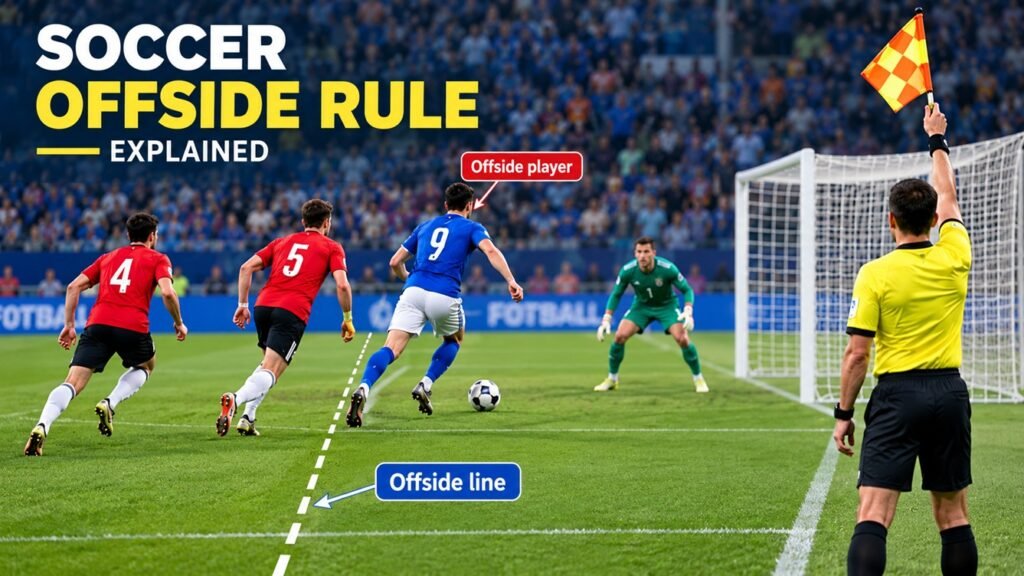
Soccer Offside Rule Explained: A Simple Guide for Beginners
Have you ever watched a football match and seen the referee stop play because of an offside call? For many new fans, the offside rule can be puzzling. A player may additionally appear ready to score; however, the referee stops play before a goal can be scored.
So, what is the football offside rule, and why is it important?
The offside rule helps prevent attacking players from gaining an unfair benefit by being too close to the opponent’s goal. In this manual, we are able to give an explanation of the guideline in simple phrases, with smooth examples that help you understand how it works.
What Is the Offside Rule in Soccer?
The offside rule is a soccer rule that limits where an attacking player may be when a teammate plays the ball ahead.
A participant can be in an offside position if:
- They are in the opponent’s half of the sphere.
- They are toward the opponent’s goal line more than both the ball and the second-to-last opponent.
However, being in an offside position is not automatically an offense. The referee only calls offside if the player will become involved in active play in a manner protected by the rule.
For instance, if a striker stands behind the defenders and gets a pass from a teammate, the referee may additionally call offside. But if the striker is in an offside position and does not intervene with play, the referee can allow play to continue.
The rule is defined in Law eleven of the reputable Laws of the Game. Read the reputable IFAB offside rule.
How Does the Soccer Offside Rule Work?
To recognize offside, you need to know three crucial things.
1. The Player Must Be inside the Opponent’s Half
A participant can’t be offside while they’re in their personal 1/2 of the field.
The midway line separates the two halves of the pitch. A participant ought to have a part of their head, body, or feet inside the opponent’s half to be in an offside position.
Standing at the midway line itself no longer counts as being in the opponent’s 1/2 for this rule.
2. The Player Must Be Ahead of the Ball and the Second-Last Opponent
When a teammate plays the ball, the referee examines the attacker’s position.
If the attacker is toward the opponent’s goal line than both the ball and the second-to-last opponent, they may be in an offside position.
The goalkeeper is frequently one of the two warring parties; however, no longer usually. The rule counts warring parties, not just the goalkeeper and one defender.
Also, the fingers and arms are not counted when deciding whether a participant is in an offside position.
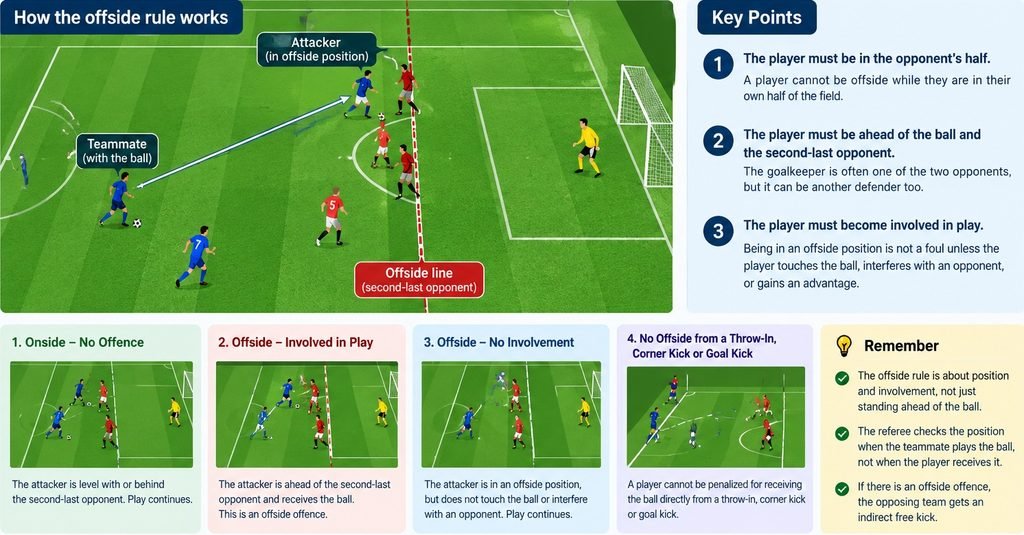
3. The Player Must Become Involved in Play
A participant in an offside position is best penalized if they become involved in energetic play.
This can show up whilst the participant:
- Plays or touches the ball from a teammate’s pass.
- Interferes with an opponent, which includes blocking the goalkeeper’s view.
- Challenges an opponent for the ball.
- Gains an advantage from a rebound or a planned store with the aid of an opponent.
If none of these items happen, truly being in an offside position is not an offence.
An Easy Example of the Offside Rule
Imagine Team A is attacking Team B’s goal.
Team A’s midfielder has the ball. Team A’s striker is standing at the back of the last defenders, towards the goal, in front of the ball.
The midfielder passes the ball forward to the striker. The striker gets it and rates.
If the striker turned into an offside position when the midfielder played the ball and then became involved in play by way of receiving the pass, the referee will normally disallow the intention.
Now, believe the striker stays in an onside role while the pass is made. The striker can run forward, get hold of the ball, and rating without committing an offside offence.
The key factor: The referee tests the player’s role whilst the teammate plays or touches the ball, not when the participant receives it.
What Is the Difference Between Onside and Offside?
Onside/Offside position: The participant is behind the second-to-last opponent or behind them. The participant is closer to the goal line than the ball and the second-to-last opponent, even if within the opponent’s half. The player can get hold of a skip without an offside offence, subject to different policies. The player can be penalized in the event that they end up in active play. The participant can run forward after the ball is played, provided they were onside at the applicable moment. The player can not avoid an offside call without a doubt by going for walks returned after the ball has been played if they were offside and then emerge as involved in play.
Being in an offside position does not automatically imply the referee will stop the game. The participant’s involvement is crucial.
Can a Player Be Offside If They Are Behind the Ball?
No. A participant is not in an offside position if they may be alongside or behind the ball while a teammate plays it, despite the fact that they are ahead of the defenders.
For instance, an attacker can bypass the ball to a teammate who is toward the intention, so long as that teammate isn’t always in advance of the ball at the time of the pass.
This is why gamers now and again run forward with the ball and bypass it sideways or backward to a teammate near the intention. The offside rule depends on the positions of the ball, the attacker, and the opponents at the relevant second.
Can You Be Offside From a Throw-In or Corner Kick?
There are 3 vital exceptions to remember.
A player cannot be penalized for receiving the ball immediately from:
- A throw-in.
- A goal kick.
- A nook kick.
For instance, if a player gets a ball without delay from a teammate’s throw-in at the same time as a pass near the opponent’s goal, there may be no offside offence.
However, once another teammate touches or plays the ball later on, the everyday offside rule can apply.
What Happens When a Player Is Offside?
When the referee calls an offside offence, play stops, and the opposing team receives an indirect free kick from the place where the offence occurred.
The attacking team generally loses possession, and the defending team receives a free kick to restart play.
In expert football, the assistant referee often raises their flag to signal an offside offence. In some competitions, the video assistant referee (VAR) era can assist officials’ assessment of close decisions, specifically when a goal is involved.
Not every offside call calls for VAR. The referee and assistant referees nonetheless make decisions for the duration of normal play.
What Is the Difference Between Offside and a Foul?
Offside and a foul are unique types of offences.
Offside is set an attacking player’s role and involvement in play while a teammate plays the ball.
A foul generally includes an illegal movement, including tripping, pushing, holding, or making an unfair challenge against an opponent.
For example, a striker can be offside without touching a defender. On the other hand, a defender can commit a foul against an attacker who is in an offside position.
Understanding this difference makes it simpler to comply with the referee’s choices during a game.
Frequently Asked Questions About the Soccer Offside Rule
1. Can a participant be offside in their personal half?
No. A participant cannot be in an offside position at the same time as they are in their own 1/2 of the field.
2. Can a player be offside if they do not contact the ball?
Yes. A player may be penalized without touching the ball in the event that they interfere with an opponent, for instance, by blocking the goalkeeper’s view or affecting an opponent’s potential to play the ball.
3. Is a player offside if they may be stage with the defender?
No. A participant who’s in the same position as the second-to-last opponent isn’t in an offside position.
four. Can a participant be offside from a corner kick?
A participant cannot be penalized for receiving the ball at once from a corner kick. The regular rule may also apply after every other teammate touches or plays the ball.
5. Why do referees wait before elevating the offside flag?
In some conditions, assistant referees delay raising the flag so that a promising attacking move can end before a near decision is made. This permits officials to study the scenario whilst the opposition’s methods call for it.
6. Does the goalkeeper constantly count as one of the two combatants?
No. The rule seems to be about the position of the second-closest opponent, whoever that participant may be. The goalkeeper is frequently one of the warring parties closest to the intention line, but the state of affairs can vary.
Final Thoughts
The football offside rule may additionally seem complex in the beginning, but the important concept is simple: an attacker can’t gain an unfair advantage by being too far ahead of the ball and the defending players when a teammate passes it, after which they become involved in play.
Remember these three points:
- The participant ought to be inside the opponent’s half.
- Their function is compared with the ball and the second one- closing the opponent.
- Being in an offside position isn’t always an offence unless the player becomes involved in live play in a way covered by the rule of thumb.
Once you apprehend these fundamentals, it becomes a great deal easier to comply with offside choices in football suits.