
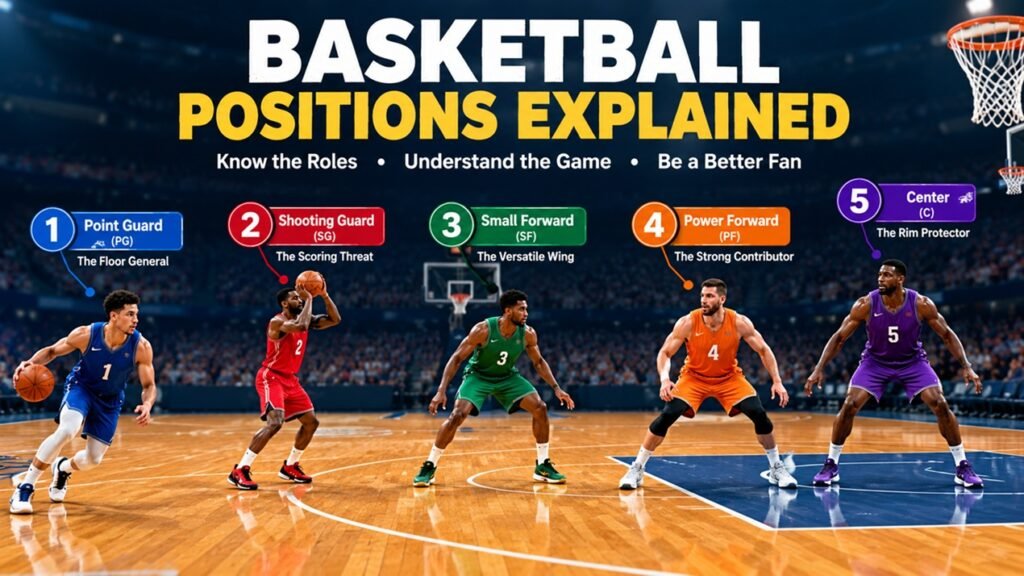
Basketball Positions Explained: A Beginner’s Guide to All 5 Positions
Basketball is a fast-paced sport in which every player has a specific role on the court. Some players create scoring opportunities, others specialize in shooting, and some focus on rebounding and protecting the basket. Understanding these roles makes it easier to follow games and appreciate how teams work together.
If you are new to the sport, learning the five traditional basketball positions is a great place to start. In this guide, we explain each position, its responsibilities, the skills players need, and how the roles differ in modern basketball.
What Are the 5 Positions in Basketball?
Traditionally, basketball has five positions: point guard, shooting guard, small forward, power forward, and center. Each position has a different primary responsibility, although players often perform several roles during a game.
Here is a quick overview:
| Position | Number | Primary Role |
| Point Guard | 1 | Handles the ball and organizes the offense |
| Shooting Guard | 2 | Scores through shooting and driving |
| Small Forward | 3 | Provides versatile scoring and defense |
| Power Forward | 4 | Rebounds, defends, and scores near or away from the basket |
| Center | 5 | Protects the rim, rebounds, and scores inside |
These positions are commonly numbered from 1 to 5, with the point guard as No. 1 and the center as No. 5. However, modern basketball is flexible, and players frequently switch roles depending on the team’s strategy.
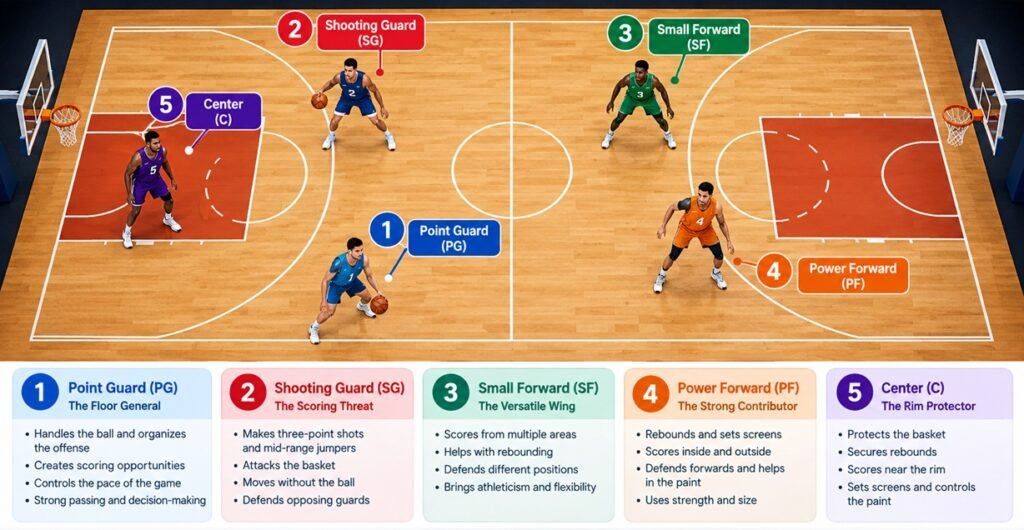
1. Point Guard (PG): The Floor General
The point guard is traditionally the team’s primary ball handler and playmaker. This player helps organize the offense, brings the ball up the court, and looks for opportunities to create shots for teammates.
Point guards need excellent court vision, ball-handling ability, passing skills, and decision-making. They must recognize defensive pressure and decide when to pass, shoot, or drive toward the basket.
Main Responsibilities of a Point Guard
- Bring the ball up the court and start offensive plays.
- Create scoring opportunities through passing.
- Control the pace of the game.
- Communicate with teammates and recognize defensive setups.
- Defend opposing guards and apply pressure on the ball.
Although many point guards are known for their passing, they can also be outstanding scorers. A good point guard balances individual scoring with making the entire team more effective.
Example: Stephen Curry is widely known for his exceptional shooting and off-ball movement, while also playing a major role in creating offensive opportunities for Golden State.
2. Shooting Guard (SG): The Scoring Threat
The shooting guard is traditionally one of the team’s main perimeter scorers. This position often involves making three-point shots, attacking the basket, and scoring from mid-range.
Shooting guards need reliable shooting technique, quick movement, good footwork, and the ability to create space against defenders. They also need defensive awareness because they frequently guard opposing perimeter players.
Main Responsibilities of a Shooting Guard
- Score through three-point shots and mid-range jumpers.
- Drive toward the basket when defenders close out.
- Move without the ball to find open shooting opportunities.
- Defend opposing guards and wings.
- Support the team’s ball movement and transition offense.
Not every shooting guard is only a shooter. Many can handle the ball, create their own shots, and serve as secondary playmakers.
Example: Devin Booker is known for his scoring ability, including mid-range shooting, perimeter offense, and creating shots under pressure.
3. Small Forward (SF): The Versatile Wing
The small forward is often considered one of the most versatile positions in basketball. Small forwards usually combine scoring, defense, athleticism, and the ability to contribute in several areas.
Depending on the team’s lineup, a small forward may guard different types of players, shoot from the perimeter, attack the basket, or help with rebounding. This flexibility makes the position especially valuable.
Main Responsibilities of a Small Forward
- Score from three-point range, mid-range, and near the basket.
- Defend opposing wings and, in some situations, larger players.
- Rebound on both ends of the court.
- Attack defensive gaps and finish fast breaks.
- Help move the ball and create opportunities for teammates.
Small forwards often need a balanced skill set rather than one specialized ability. Size, speed, strength, and basketball intelligence can all be important.
Example: LeBron James has played extensively as a small forward and is known for his combination of scoring, passing, physical strength, and defensive versatility.
4. Power Forward (PF): The Strong and Versatile Forward
The power forward traditionally plays closer to the basket than the small forward. This player helps secure rebounds, defend bigger opponents, set screens, and score in the paint.
Modern power forwards often have additional skills, including three-point shooting and perimeter defense. Some play almost like centers, while others operate farther from the basket to create more space for their teammates.
Main Responsibilities of a Power Forward
- Collect offensive and defensive rebounds.
- Defend opposing forwards and help protect the paint.
- Set screens to free teammates for shots or drives.
- Score near the basket and from mid-range.
- Stretch the floor by shooting three-pointers when capable.
A strong power forward can help a team control the boards while also creating mismatches against smaller or slower defenders.
Example: Giannis Antetokounmpo is known for his strength, ability to attack the basket, rebounding, and defensive versatility. His role can extend beyond the traditional power-forward responsibilities.
5. Center (C): The Rim Protector
The center is traditionally the team’s tallest or biggest interior player. Centers often operate near the basket and play a major role in rebounding, interior defense, and scoring close to the rim.
However, height alone does not determine whether someone is a center. Strength, positioning, defensive awareness, and the ability to contribute to a team’s system are also important.
Main Responsibilities of a Center
- Protect the rim and challenge opponents’ shots.
- Secure rebounds on both end of the court.
- Score through layups, dunks, post moves, and close-range shots.
- Set screens for guards and forwards.
- Help teammates defensively when opponents drive into the paint.
Some modern centers can also pass effectively, shoot from long range, and initiate offensive plays. These abilities make them more versatile than the traditional inside-only center.
Example: Nikola Jokić is known for combining interior scoring and rebounding with exceptional passing and playmaking, making him one of the most versatile centers in the game.
Basketball Positions Comparison: Key Differences
Understanding the differences between the five positions can help beginners recognize each player’s role during a game.
| Position | Typical Strength | Common Offensive Role | Common Defensive Role |
| Point Guard | Ball handling and passing | Organizes plays | Guards the ball handler |
| Shooting Guard | Shooting and scoring | Creates perimeter shots | Defends guards |
| Small Forward | All-around versatility | Scores from multiple areas | Guards wings |
| Power Forward | Strength and rebounding | Sets screens and scores inside or outside | Defends forwards and helps in the paint |
| Center | Interior presence | Scores near the basket and sets screens | Protects the rim and rebounds |
These are traditional tendencies, not strict rules. A team’s system, player abilities, and matchup can change how each position operates.
Does Height Determine Your Basketball Position?
Height can influence which position a player is best suited for, but it is not the only factor. Guards are often smaller and quicker, while centers are generally taller and stronger. Forwards usually fall somewhere between these traditional profiles.
However, there are many exceptions. A tall player with excellent ball-handling and passing skills may function as a playmaker, while a smaller player with strength and good positioning may contribute effectively near the basket.
When choosing a position, players should consider their skills, physical attributes, basketball IQ, and the needs of their team.
What Is Positionless Basketball?
Positionless basketball is a modern approach in which players are not restricted to one traditional role. Instead, teams use players’ individual strengths to create flexible lineups and favorable matchups.
For example, a forward might handle the ball like a point guard, a center might shoot three-pointers, and a shooting guard might defend a much taller opponent. These combinations can make offenses harder to predict and defenses more difficult to organize.
Positionless basketball does not mean that traditional positions have disappeared. Teams still need ball handlers, scorers, rebounders, and rim protectors. The difference is that one player may perform several of these jobs.
How Do You Choose the Right Basketball Position?
If you are learning basketball or joining a team, start by identifying your strongest skills. Your ideal position may change as you improve, grow, or develop new abilities.
Here are some general guidelines:
- Choose point guard if you enjoy handling the ball, passing, communicating, and making decisions.
- Choose shooting guard if you are a confident shooter who can also attack the basket.
- Choose small forward if you have a balanced skill set and enjoy contributing in different ways.
- Choose power forward if you are strong, comfortable rebounding, and willing to defend physically.
- Choose center if you have the size, positioning, and interior skills to protect the basket and rebound.
These are starting points, not requirements. Players of different heights and body types can succeed at multiple positions by developing the right skills.
Frequently Asked Questions
What are the five positions in basketball?
The five traditional basketball positions are pointing guard, shooting guard, small forward, power forward, and center. Each has a different primary role, although modern players often perform responsibilities associated with multiple positions.
Which basketball position scores the most points?
There is no single position that always scores the most. Shooting guards, small forwards, and point guards can be major scorers, while power forwards and centers may also lead their teams in scoring. The result depends on the player, team strategy, and playing style.
Which is the most important position in basketball?
Every position contributes to winning. A skilled point guard may organize the offense, a reliable shooter may create scoring opportunities, and a strong center may protect the rim. The most important role depends on the team’s strengths and weaknesses.
Can a basketball player play more than one position?
Yes. Many players can play two or more positions. For example, a player might be a shooting guard on offense but defend small forwards on the other end. Coaches often adjust positions to suit matchups and team strategy.
What is the difference between a point guard and a shooting guard?
A point guard traditionally focuses more on organizing the offense, handling the ball, and creating opportunities for teammates. A shooting guard traditionally focuses more on scoring from the perimeter and attacking the basket. In modern basketball, both positions can share playmaking and scoring duties.
What is the difference between a power forward and a center?
A power forward traditionally plays as a forward who rebounds, sets screens, and scores inside or outside. A center generally focuses more on interior defense, rim protection, and scoring near the basket. Modern players can blur these distinctions.
Final Thoughts
Understanding basketball positions makes it easier to follow the game, recognize player responsibilities, and appreciate team strategy. The point guard organizes the offense, the shooting guard provides scoring, the small forward offers versatility, the power forward contributes strength and rebounding, and the center anchors the interior.
Although these traditional roles remain useful, modern basketball gives players more freedom to develop different skills and perform multiple responsibilities. The best teams use each player’s strengths while ensuring that all five players work together.
Whether you are a beginner, a young player learning the game, or an NBA fan, understanding these five positions is a useful foundation for enjoying basketball.